What Records Must a Sole Trader Keep?
As a sole trader, HMRC requires you to keep records of all your business income and expenses. You must keep these records for at least 5 years after the 31 January submission deadline of the relevant tax year.
Your records should include:
All money spent — purchase invoices, receipts, bank statements showing payments.
VAT records (if VAT-registered) — VAT charged on sales, VAT paid on purchases.
Your personal income — if you have other income sources, these must be declared too.
Getting Started with ComptaFlow UK
Here's how to set up your bookkeeping as a sole trader:
- Install the plugin — Download ComptaFlow UK from WordPress.org (free) or get the Pro version from our website.
- Configure your business — Go to Settings and enter your business name, UTR number, and VAT scheme (or "Not registered" if below threshold).
- Enter your income — Record each sale or payment received. The guided system suggests the right nominal code automatically.
- Record your expenses — Enter every business expense with receipt date, amount, and category.
- Review weekly — Check your journal entries are correct. The dashboard shows your running totals.
- Export at year end — Generate your Profit & Loss and Audit Trail for your Self Assessment.
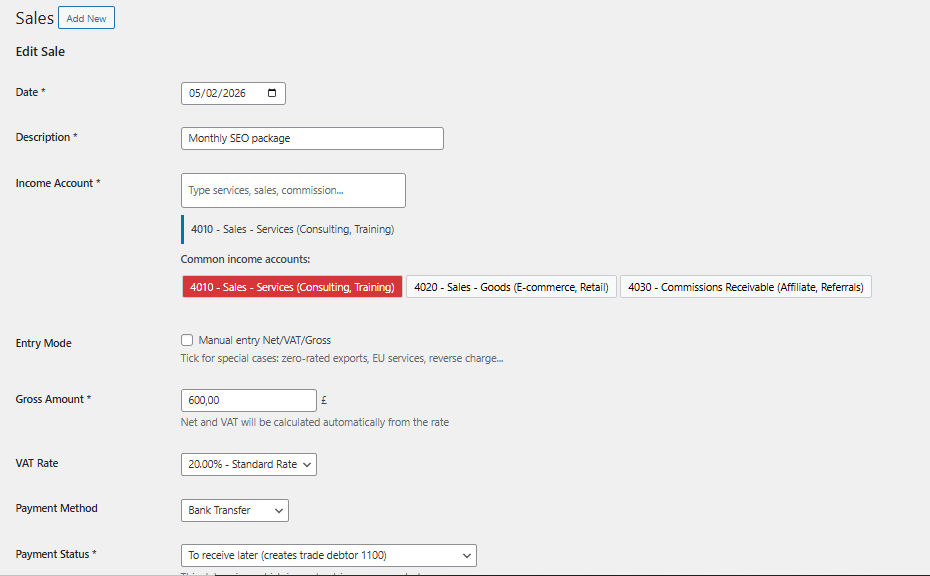
Guided entry — type a description and the nominal code is suggested automatically
Common Allowable Expenses
As a sole trader, you can deduct legitimate business expenses from your income to reduce your tax bill. Here are the most common categories — all supported by ComptaFlow UK's nominal codes:
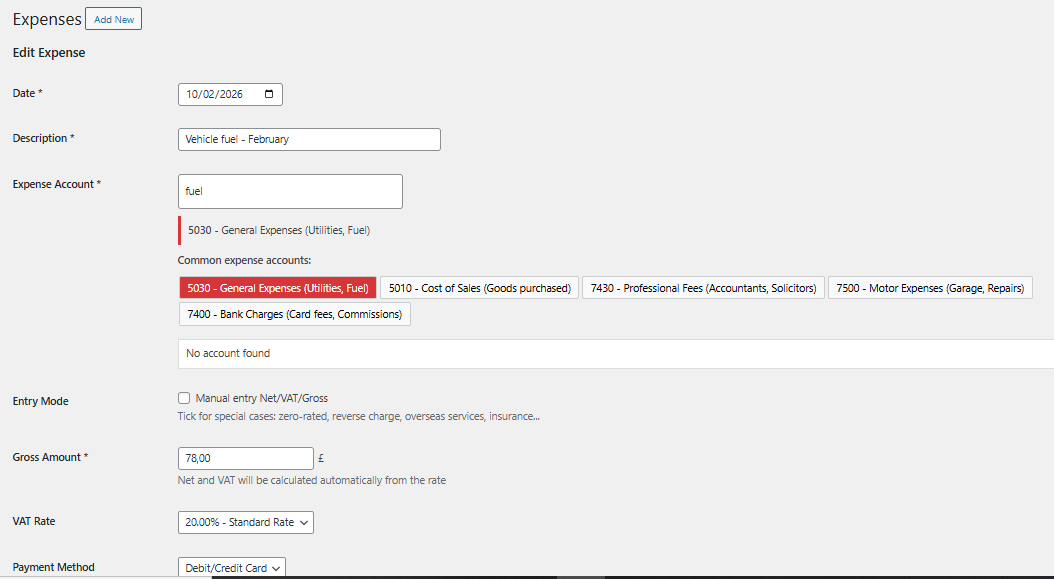
Enter an expense — the nominal code is suggested based on your description
Self Assessment: What You Need
Every year, you must file a Self Assessment tax return with HMRC. The deadline for online filing is 31 January following the end of the tax year (5 April). For the 2025/26 tax year, your deadline is 31 January 2027.
What ComptaFlow UK Provides for Self Assessment
When it's time to file, ComptaFlow UK gives you everything you need:
Audit Trail — Complete record of every entry, in case HMRC asks for supporting evidence.
Trial Balance — Confirms your books balance correctly before filing.
VAT summary — If VAT-registered, your total VAT collected and paid for the year.
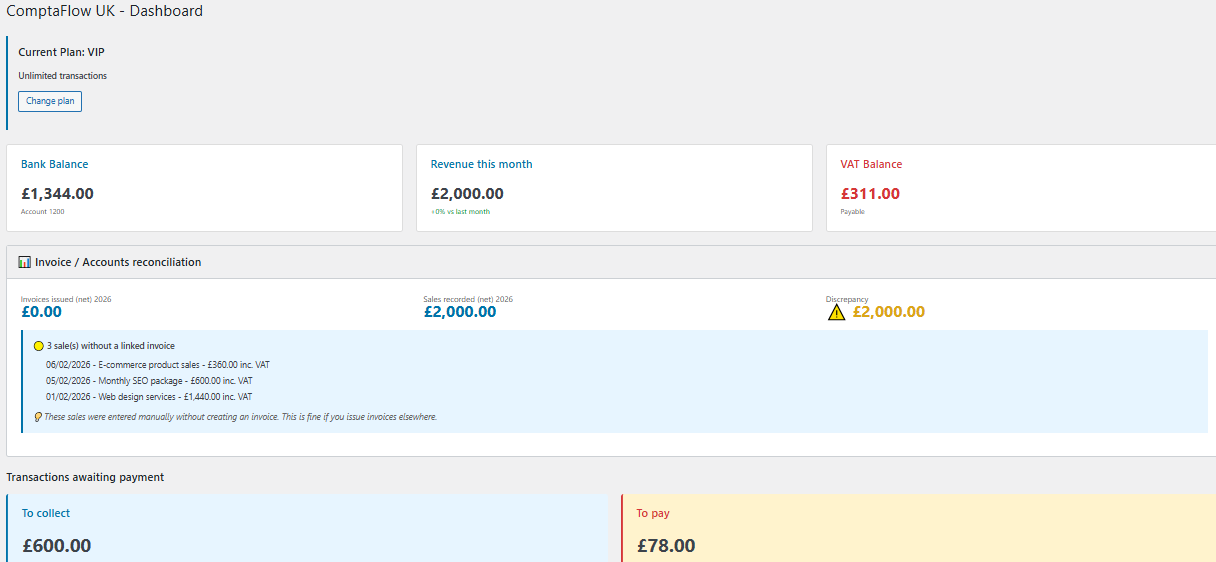
Your dashboard — revenue, expenses, and VAT position at a glance
Should You Hire an Accountant?
ComptaFlow UK is designed as a bookkeeping assistance tool — it helps you keep accurate daily records. For year-end filing, we always recommend working with a qualified accountant or tax adviser, especially if:
• Your turnover exceeds £85,000
• You have complex income sources (property, investments)
• You're approaching the VAT threshold
• You need advice on tax planning or business structure
• It's your first Self Assessment
ComptaFlow UK makes your accountant's job easier by providing clean, organised records in standard export formats. Many sole traders find that good bookkeeping throughout the year significantly reduces their accountancy fees.
Start Your Bookkeeping Today
Free version on WordPress.org for basic bookkeeping. Pro plans from £9.99/month with invoicing, bank reconciliation, and more. 30-day free trial.