Understanding Your Tax Year
The UK tax year runs from 6 April to 5 April the following year. However, limited companies can choose their own accounting year end (most commonly 31 March or 31 December). ComptaFlow UK supports both the standard tax year and custom accounting periods.
Limited companies: Your accounting year end is set at incorporation (usually 12 months after). You file accounts with Companies House and a Corporation Tax return with HMRC.
Key Deadlines
| Business Type | Filing | Deadline |
|---|---|---|
| Sole Trader | Self Assessment (online) | 31 January following the tax year |
| Sole Trader | Payment on account | 31 January + 31 July |
| Limited Company | Annual accounts (Companies House) | 9 months after year end |
| Limited Company | Corporation Tax return (HMRC) | 12 months after year end |
| Limited Company | Corporation Tax payment | 9 months + 1 day after year end |
| Partnership | Partnership return | 31 January following the tax year |
Year-End Reports in ComptaFlow UK
ComptaFlow UK Pro generates the key year-end reports your accountant needs:
📋 Balance Sheet
- Fixed assets & depreciation
- Current assets (debtors, bank, cash)
- Current liabilities (creditors, VAT owing)
- Capital & reserves
- Net assets calculation
📊 Profit & Loss
- Turnover / Revenue
- Cost of sales
- Gross profit
- Administrative expenses
- Net profit before tax
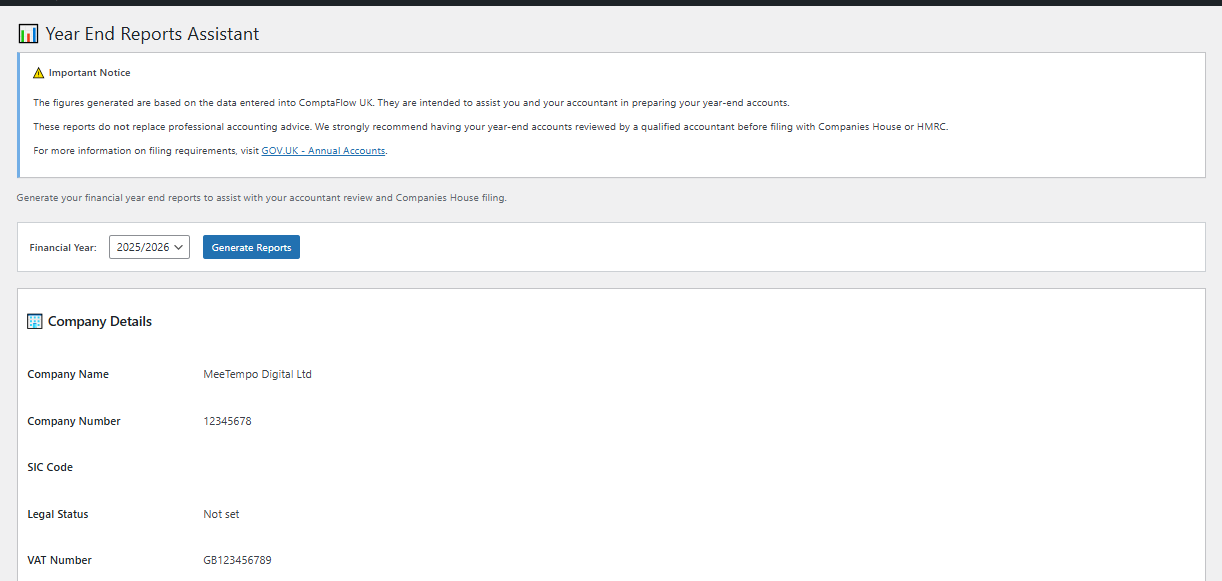
Balance Sheet — generated automatically from your daily entries
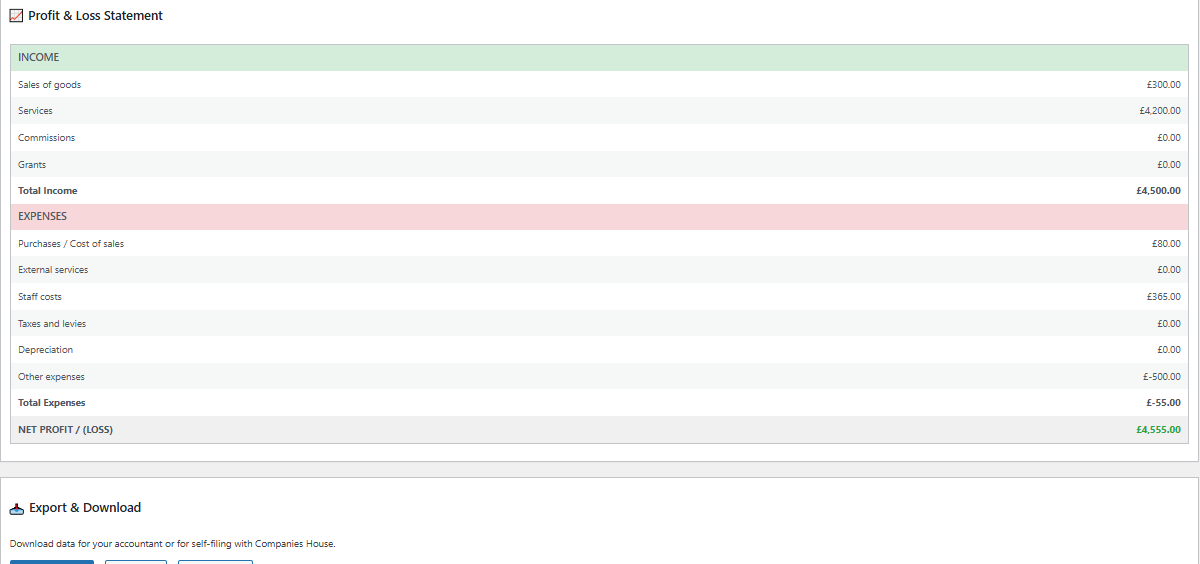
Profit & Loss statement — revenue, expenses, and net profit at a glance
Year-End Checklist
Before closing your books, make sure you've completed these steps:
2. Check outstanding invoices — Chase any unpaid sales invoices. Record bad debts if necessary.
3. Record depreciation — Run depreciation for all fixed assets through the year end date.
4. Review VAT — Ensure all quarterly VAT returns have been submitted and paid.
5. Export your reports — Generate the Audit Trail, Trial Balance, P&L, and Balance Sheet.
6. Back up everything — Use ComptaFlow UK's Backup feature before closing.
7. Send to your accountant — Share the exports with your accountant for review and filing.
Additional Year-End Exports
Beyond the Balance Sheet and P&L, ComptaFlow UK generates these essential exports:
📑 Audit Trail
A complete chronological record of every transaction and journal entry. This is the primary document HMRC may request during a tax inspection.
⚖️ Trial Balance
Shows the closing balance of every nominal account at year end. Your accountant uses this to verify that debits equal credits and the books are in order.
📖 General Ledger
Detailed movements for each nominal account, showing every transaction that affected the balance. Essential for your accountant to review individual accounts.
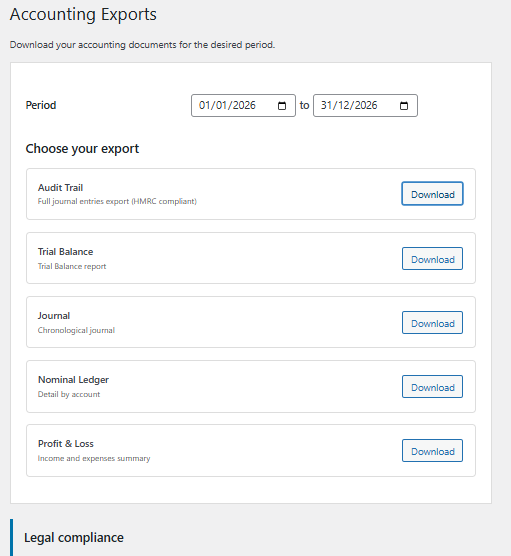
All year-end exports available in one click — Audit Trail, Trial Balance, General Ledger, Journal, P&L
Prepare Your Year-End with Confidence
Generate professional year-end reports directly from WordPress. Pro plans from £9.99/month with a 30-day free trial.